
Accelerate certification with reliable technical evidence
Our platform produces the evidence certifiers and regulators require: audit trails, validated test criteria and confidence intervals for safety cases. Built alongside leading auditing and certification organizations.
QuantPi TIC Partners




Built with certifiers
Aligned with standardization
Pre-validated with regulators
From regulatory requirements to verifiable test criteria
Build your evidence layer for validated compliance processes of regulated use cases such as physical AI, autonomous vehicles or robotics. QuantPi collaborates with renowned TIC partners to translate complex regulatory requirements into verifiable testing criteria.






Audit and Certification
QuantPi’s TIC partners support your full audit readiness and preparation with:
Test Criteria and Methods
The selection and parameterization of technical assessment metrics need to be justified in the context of applicable regulation. We have successfully collaborated with TIC partners on conformity assessments in the context of the following exemplary references:
03 · In practice
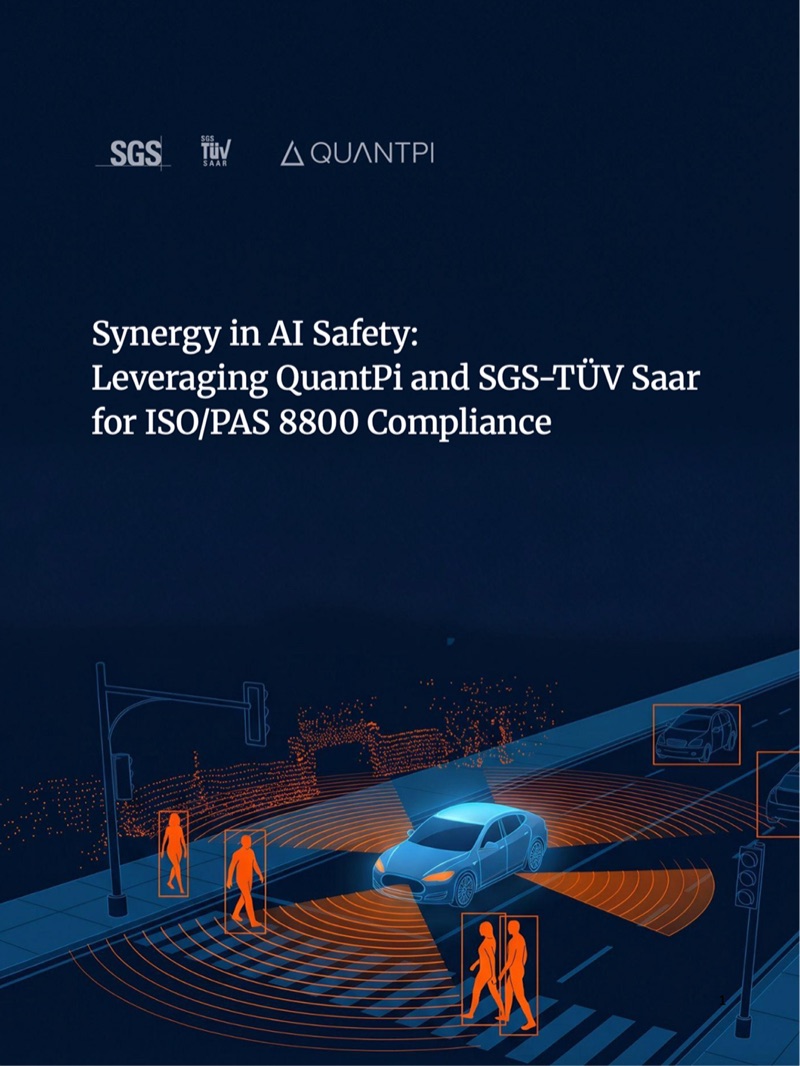
Leveraging QuantPi and SGS-TÜV Saar for ISO/PAS 8800 compliance
SGS-TÜV Saar and QuantPi jointly offer a fast track to ISO/PAS 8800 certification based on reliable technical evidence. Read the white paper to explore how the two partners enable automotive suppliers and OEMs to reach certification of their AI systems faster.
Uncovering bias in AI recruitment
Explore how the QuantPi platform is used in real-world assurance cases. Read our white paper with TÜV AI.Lab and StepStone on uncovering bias in AI recruitment with a legally assured methodology to assess a candidate recommender system under European regulation.
Fast track to physical AI certifications by TÜV Süd
Physical AI is entering regulated markets. Every robot, autonomous vehicle, and AI-driven machine must prove that its AI behaves safely. Legislation such as the Machinery Regulation makes that proof mandatory, not optional. Until now, there was no established way to turn AI tests into certification-ready evidence. Benchmarks don’t convince a notified body. Statistical guarantees do. As TÜV SÜD’s first CARAT partner laboratory for AI testing worldwide, QuantPi closes that gap. We provide the missing link between having AI systems deployed and having them certified and ready to scale.
Receive statistically valid test results that a notified body will accept as evidence. QuantPi assesses AI systems under an ISO/IEC 17025-aligned quality management system, so every result is traceable and auditable. The outcome: shorter certification cycles, lower cost, and a credible path from prototype to mass deployment. The approach supports emerging AI testing standards such as ISO/IEC TS 42119, ETSI TR 103 910, and ISO/IEC 5259, as well as physical AI safety standards including ISO/PAS 8800 and ISO/IEC TS 22440.

Accelerating Physical AI Safety Certification
QuantPi is a member of the NVIDIA Halos AI Systems Inspection Lab, the industry’s first program accredited by the ANSI National Accreditation Board (ANAB) to provide a unified framework for functional safety, cybersecurity, and AI compliance. NVIDIA Halos is a comprehensive full‑stack safety system for physical AI that unifies safety elements across vehicle and robotics architectures and their underlying AI models.
The QuantPi platform delivers scalable technical validation with statistical confidence across diverse metrics, including robustness, fairness, and performance. These capabilities help streamline the validation process for physical AI deployments, ensuring they meet emerging AI‑specific standards like ISO PAS 8800, ISO/IEC TR 5469 and ISO/IEC TS 22440.


Test AI systems according
to existing and future standards
QuantPi contributes to multiple standardization committees at German and European level to define the future of AI quality. Our contributions focus on reliability requirements for AI testing tools.





How the QuantPi Platform supports your path to fast certification
We provide the specialized tooling required to satisfy rigorous audit requirements while maintaining speed of development.
Out-of-the-box test coverage
Hundreds of test scenarios aligned with international standards and regulation are available by default.
Customization to your concrete operating domain
Adapt test scenarios for in-context evaluations according to the operational design domain (ODD) of AI systems.
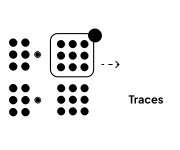
Extension of test coverage
Broaden test coverage with automated data annotation for deeper insights into AI system strengths and failure modes.

Pre-validated metrics and reporting
Assessment metrics and audit traces which are pre-validated with market surveillance authorities and certification bodies.
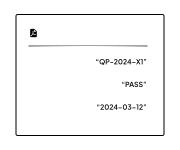
Transparent documentation
Auto-generated PDF-reports covering the entire assessment, or JSON exports with the complete audit traces prioritized according to criticality.
